
STEP 01
Website
Your important pages, content and technical foundation.
I identify and fix technical SEO issues that can affect crawling, indexing, site performance and how clearly search engines understand your website.
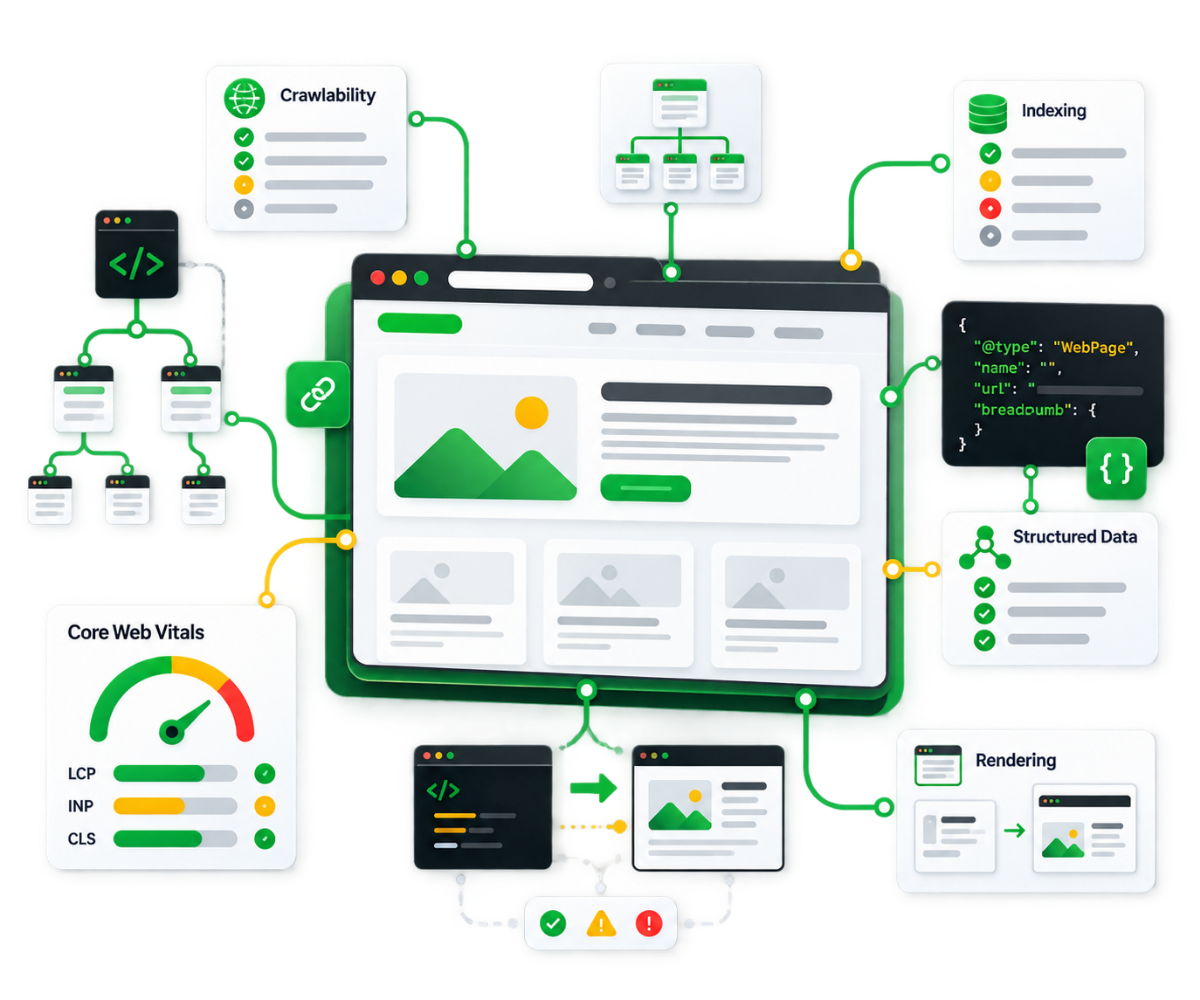
A website can look completely normal to visitors while technical issues make it harder for search engines to crawl, render, index or understand important pages correctly.
Your important pages, content and technical foundation.
Can search engines reach and move through important pages?
Can important content and page elements be processed clearly?
Is the right page version available and understood for search?
Clearer technical signals help search systems interpret the site.
Technical barriers can interrupt how search engines move through the website and reach priority content.
Technical inconsistencies can make it less clear which pages or versions should appear in search.
Rendering, page experience and Core Web Vitals can affect how efficiently the website performs for users and search systems.
Cleaner architecture and structured signals can make important relationships easier for search systems to interpret.
Crawlability, performance, indexation and search understanding work together. Strengthening one layer without considering the others can leave important technical gaps behind.
Improve the technical paths that help search engines discover priority pages and move through the website efficiently.
Improve rendering, responsiveness and the technical experience behind Core Web Vitals and page performance.
Create clearer technical signals around page versions, canonicalisation and which URLs should be available in search.
Strengthen architecture and structured data so page relationships and important website entities are easier to interpret.
Help important pages become easier to reach.
Support faster and more stable page experiences.
Reinforce which URLs should matter in search.
Make website relationships easier to interpret.
The goal is to improve how the website is discovered, processed, indexed and understood as a complete system.
Website performance is not only about a speed score. It is about how quickly useful content appears, how responsive the page feels and how stable the experience remains while visitors use it.
A stronger loading experience helps visitors reach the main content without unnecessary waiting.
Buttons, menus and page interactions should respond clearly when a visitor takes action.
A stable layout reduces unexpected movement that can interrupt reading, navigation or customer actions.
Technical performance creates a stronger experience for users while supporting the website's overall search foundation.
Strong site architecture helps important pages stay connected, easier to discover and easier for search engines to understand within the wider website.
Main website direction
Important commercial topics
Useful supporting information
Focused search intent
Clearer paths help search engines move through related parts of the website more efficiently.
A logical hierarchy helps communicate which pages are central and how supporting content relates to them.
Contextual connections help visitors and search systems move naturally between related pages.
When similar URLs, duplicate versions or conflicting technical signals exist, search engines may have a less clear view of which page should represent the content in search.
One version of the page.
Another version may send similar signals.
Search engines may need to interpret the relationship.
Technical signals work together to reinforce which page should represent the content.
Your pages contain information for people, but search systems also need clear technical context around what the page represents and how its important entities relate to each other.
What the page is primarily about.
The business, person, service or topic represented.
How important information relates across the website.
Modern websites can depend heavily on JavaScript. If important content, links or page elements are difficult to process, search engines may not receive the same complete experience that visitors see.
Search systems should be able to follow the paths that connect important pages across the website.
Critical information should not depend on a fragile rendering path that makes important content harder to interpret.
A clearer technical setup helps reduce the gap between what visitors see and what search engines can process.
I focus first on the issues that can create the biggest technical barriers, then improve the foundation, validate the changes and keep an eye on how the website behaves over time.
I review how the website is crawled, indexed, rendered, structured and experienced technically before deciding what deserves attention.
Technical problems are not treated equally. Priority is given to issues that can more directly affect important pages, search access or website performance.
The website is improved around the technical areas creating friction, while keeping usability, search access and the wider site structure connected.
Technical improvements are reviewed again so important pages, signals and website behaviour can be checked after the changes.
Ongoing technical signals can reveal new crawl, indexation or performance issues as the website grows and changes.
You do not need to understand every technical SEO term to know something is wrong. Certain website situations are strong signs that the technical foundation deserves a closer look.
Pages exist on the website, but some important URLs are missing, excluded or behaving unexpectedly in search.
A sudden or gradual decline can sometimes be connected to crawl, indexation, migration, rendering or broader technical changes.
Major website changes can affect URLs, redirects, internal paths and indexation if the technical transition is not handled clearly.
Slow loading, poor responsiveness or shifting layouts can create friction for visitors and weaken the technical experience.
Larger websites can develop crawl paths, duplication, indexation and architecture issues that are harder to notice manually.
As new content, services and functionality are added, technical inconsistencies can accumulate quietly in the background.
Technical SEO can sound complicated, but the important questions are usually straightforward: what is wrong, what matters most and what should happen next.
Technical SEO improves the technical foundation that helps search engines crawl, render, index and understand important website pages while also supporting performance and usability.
Common warning signs include important pages not being indexed, unexpected organic visibility changes, crawl errors, slow or unstable pages, duplicate URLs and problems after a website redesign or migration.
Technical SEO does not guarantee rankings, but it can remove barriers that make important pages harder to crawl, index, process or experience properly, creating a stronger foundation for wider SEO work.
Yes. Core Web Vitals evaluate important aspects of loading, responsiveness and visual stability, so they are commonly reviewed as part of website performance and technical SEO.
Canonical and indexation issues can occur when multiple URLs or conflicting technical signals make it less clear which page version should be treated as the preferred version for search.
Yes. JavaScript can affect SEO when important content, navigation or links depend on rendering in ways that make them harder for search engines to access or process reliably.
No. Structured data can provide clearer machine-readable context, but adding valid schema does not guarantee that Google will show a rich result or any particular search feature.
It depends on the issue and website setup. Some improvements can be handled directly, while others may require developer access or clear implementation guidance for your development team.
If crawlability, indexation, performance, rendering or website structure is holding your SEO back, I can help you identify the important technical barriers and decide what should be improved first.