
If you want to learn how to improve website SEO ranking, begin by identifying why the right page is not performing. The usual constraint is crawlability, relevance, content quality, page experience, authority or a combination of these.
Do not change titles, publish articles and build links at random. Establish your baseline, fix the biggest obstacle and verify the effect before moving to the next layer.
How to Improve Website SEO Ranking in the Right Order
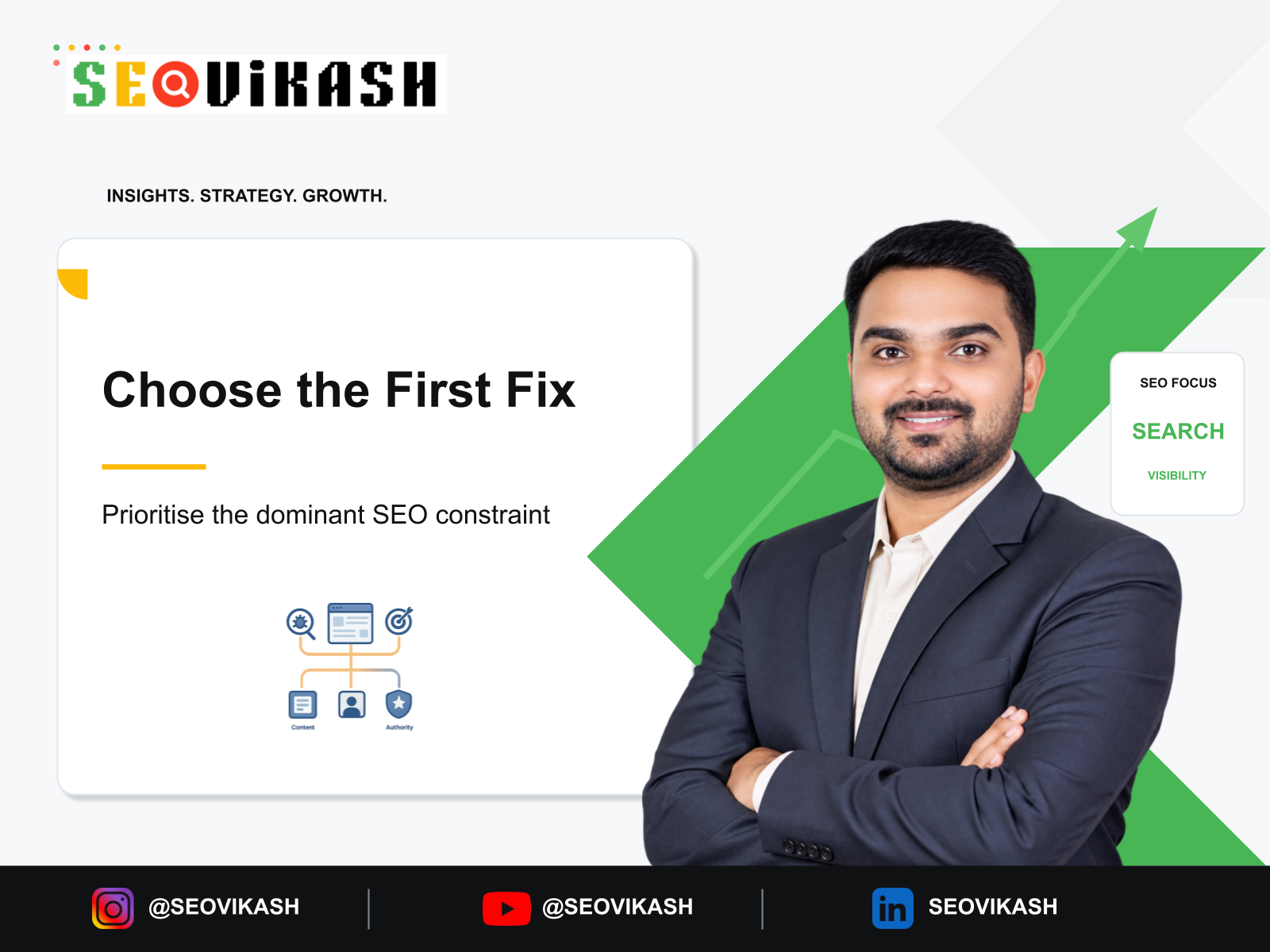
SEO improves when you fix the biggest constraint first, not when you complete the longest checklist.
A useful priority order is:
- Confirm that important pages can be crawled and indexed.
- Choose one clear search purpose for each page.
- Make the content satisfy that purpose better.
- Clarify page structure and internal relationships.
- Remove usability and performance barriers.
- Build legitimate external authority where needed.
- Measure results and repeat the diagnosis.
Before changing anything, record current impressions, clicks, queries, landing pages and conversions. Google Search Console is the best starting point for Google Search performance, while analytics data helps you understand what visitors do after arriving.
Review individual pages rather than relying only on site-wide averages. A website can contain growing pages, declining pages and pages that have never been eligible to compete.
Fix Crawling and Indexing Problems First
A page cannot rank reliably if search engines cannot crawl, index or understand it.
Inspect your important URLs in Search Console and check whether they are indexed. If they are excluded, investigate the stated reason rather than repeatedly requesting indexing.
Check the common technical barriers
- A robots.txt rule prevents crawling.
- A noindex directive excludes the page.
- The canonical tag points to another URL.
- The page redirects, returns an error or loads unreliably.
- Important content depends on JavaScript that is not rendered correctly.
- The page is orphaned and receives no internal links.
- Near-duplicate URLs divide signals or confuse canonical selection.
Create an XML sitemap containing the canonical URLs you want discovered and submit it through Search Console. Remember that a sitemap assists discovery; it does not guarantee indexing or higher rankings.
After fixing a problem, test the live URL and request indexing where appropriate. Then monitor the indexing report instead of assuming the repair worked.
Match Every Page to a Clear Search Intent
An indexed page can still perform poorly when it answers the wrong question or uses the wrong format.
Choose a primary query for each important page and examine what the searcher is trying to accomplish. They may want instructions, a definition, a comparison, a product, a service provider or a specific website.
For example, a detailed educational article is unlikely to be the best page for a strongly transactional product query. A short product page is equally unlikely to satisfy someone seeking a complete troubleshooting guide.
Compare the page with the search results
Review the dominant page type, format and scope appearing for the target query. This is not an instruction to copy competitors; it helps you understand the minimum form of answer searchers expect.
Ask whether your page:
- addresses the same underlying problem;
- uses a suitable format;
- covers the necessary subtopics;
- serves the correct audience and stage of awareness;
- offers a credible reason to choose or trust the answer.
If two of your pages target essentially the same purpose, decide which should be the primary page. Merge overlapping information, differentiate their intent or redirect a weaker duplicate when that is technically appropriate.
Improve Content Usefulness Before Adding More Keywords
Adding repetitions of a keyword cannot repair an incomplete, vague or untrustworthy answer.
Read the page from the visitor’s perspective. Can they understand the answer quickly, complete the task and recognise important limitations without returning to search
Improve weak content by adding missing explanations, practical steps, original professional insight, clear examples and evidence where factual claims require support. Remove filler that merely restates the heading.
Show why the information deserves trust
Use accurate author information, transparent business details and appropriate sources. If the topic depends on first-hand knowledge, explain the relevant experience without inventing credentials or results.
For a service page, describe what is included, who it suits, realistic outcomes and what affects scope. For an informational page, give the solution instead of withholding essential steps behind an enquiry form.
Do not refresh publication dates unless the content has been meaningfully reviewed or updated. Freshness matters when the subject changes, but a cosmetic date change does not make an old answer more useful.
Related SEO Resources
Strengthen On-Page SEO and Internal Links
Once the page satisfies its search purpose, make its subject easy for readers and search engines to understand.
- Write a descriptive title that accurately summarises the page.
- Use one clear main heading and logically ordered subheadings.
- Include the primary topic naturally in prominent areas.
- Use a short, descriptive URL where practical.
- Write a useful meta description that sets accurate expectations.
- Add descriptive image alt text when an image conveys information.
- Use structured data only when it accurately represents visible content.
Avoid forcing every keyword variation into the copy. Search systems can understand closely related language, while readers notice awkward repetition immediately.
Internal links are not decoration; they show relationships, priority and useful next steps.
Link to important pages from relevant, established pages using anchor text that explains the destination. Every page you care about should be reachable through the website’s normal navigation or contextual links.
A hypothetical software website might link from an invoicing guide to its invoice-template page because the next resource genuinely helps the reader. Adding unrelated links merely to distribute authority would make the journey less useful.
Improve Page Experience Without Chasing Perfect Scores
Google considers Core Web Vitals within a wider assessment of page experience, but a perfect performance score does not guarantee a top ranking.
Prioritise problems that materially affect visitors:
- slow loading of the main content;
- buttons or layouts that move during interaction;
- delayed responses after a click or tap;
- poor mobile readability;
- intrusive pop-ups that obscure the page;
- confusing navigation or inaccessible controls;
- security warnings or broken functionality.
Test representative templates rather than only the homepage. Product pages, articles and service pages may use different scripts, layouts and media.
Compress oversized images, remove unnecessary scripts, use effective caching and simplify overloaded templates where the evidence supports it. Redesigning the entire website is unnecessary when a targeted template or code improvement can solve the problem.
Build Authority Without Risky Link Schemes
Useful content and sound technical foundations may not be enough in a competitive topic where established pages have stronger external recognition.
Earn relevant mentions by publishing resources worth referencing, contributing genuine expertise, maintaining accurate business profiles and promoting useful work to appropriate audiences. Partnerships, digital PR and industry resources can help when they create real editorial value.
Avoid buying bulk links, exchanging links at scale or publishing low-quality guest posts solely for anchor text. These tactics can waste money and create unnecessary search risk.
Before pursuing links, confirm that the target page deserves them. Promotion cannot permanently compensate for a page that fails to answer the query.
Measure Results and Troubleshoot the Next Constraint
Measure page-level changes, not just the website’s average position.
Annotate substantial edits and compare suitable periods in Search Console. Allow for seasonality, location, device differences and normal ranking fluctuations before assigning credit to a change.
Use the performance symptom to choose the next action
- No impressions:check indexing, internal links, query targeting and whether demand exists.
- Impressions but poor positions:reassess intent, completeness, authority and competing pages.
- Good positions but few clicks:improve the title, snippet relevance and value proposition.
- Clicks but weak engagement:check whether the page fulfils the promise made in search.
- Traffic without enquiries:examine audience fit, page clarity, trust and conversion usability.
Change one meaningful group of issues at a time when possible. If you rewrite content, alter URLs, change internal links and redesign the template simultaneously, identifying what helped becomes difficult.
Professional SEO support becomes sensible when several constraints overlap, a migration is involved, valuable rankings could be disrupted or technical evidence conflicts. A responsible review should identify priorities rather than recommend the largest possible project automatically.

Turn SEO Problems Into Priorities
Share your website and the ranking problem you want to solve so Vikash can identify which technical, content or relevance areas deserve attention first.
FAQs
How long does it take to improve a website’s SEO ranking?
There is no universal timeline. Results depend on indexing, competition, website authority, the severity of existing problems and how quickly useful changes are implemented and recrawled.
Can I improve SEO rankings without paid tools?
Yes. Google Search Console, analytics data, manual search-result reviews and basic performance tools can reveal many valuable opportunities before paid software becomes necessary.
Should I update old content or publish new pages?
Update an existing page when it already targets the correct intent but is incomplete or outdated. Publish a new page when the query represents a genuinely different purpose that deserves its own answer.
Do backlinks always improve rankings?
No. Relevant editorial links can support authority, but links cannot guarantee rankings or repair poor intent alignment, indexing problems or weak content.
What should I fix first if several SEO problems exist?
Fix anything preventing crawling or indexing first. Then prioritise the pages with meaningful business value and the clearest evidence of relevance, content, experience or authority gaps.
Final Words
The practical answer to improving SEO rankings is to remove constraints in the correct order: discovery first, relevance next, usefulness and clarity after that, then experience and authority.
Keep measuring because SEO is not a one-time configuration. Search behaviour, competitors, websites and user expectations change, so the strongest improvement process is diagnostic and continuous.

Vikash Shukla is the SEO professional behind SEO Vikash, working across technical SEO, website SEO, local search, on-page optimization, AI search visibility and SEO-focused website development.